Tuesday, June 7, 2011

What Would You Grab?

Kerry Scott over at Clue Wagon posted this interesting question:

Your house is in fire.  Your loved ones are safely out.  You have time to grab only one thing. 
What do you grab?  Why?
Wow!  This is a very tough question for most people, as every thing you think of  leads to other things, and you get stuck deciding which is most valuable to you.

I'm torn between grabbing the stack of my grandmother's photo albums (it's a neat stack, as easy to grab as one individual album, so I'm counting the stack as one object), most of which are still waiting to be scanned, or my computer, which has all of my other data, and is never quite as well backed up as I might want.  Or maybe the binder with grandma's hand-written memoirs?  Those still need to be transcribed.  Never mind the shelves full of books, some of them first editions.  Never mind clothes, or food, or furniture, those can be replaced.  What about the lockbox full of important papers? 

I  hate this kind of question, as I never feel like I can make a satisfactory answer.  Any way I choose, I lose something irreplaceable of great value to me, and I don't like that feeling.  In reality, I'd probably risk life and limb to get more stuff out of the fire.

So, your turn!  Post a comment here on how you would answer that question, or make a blog post if you prefer.  What do you grab?  Why?

Sunday, June 5, 2011

This Is The Face Of Genealogy

Estel E. and Alta M. (Day) Dillman

52 Weeks of Personal Genealogy & History - Secrets

I'm a little late with this one, but here goes...

52 Weeks of Personal Genealogy & History by Amy Coffin is a series of weekly blogging prompts (one for each week of 2011) that invite genealogists and others to record memories and insights about their own lives for future descendants. You do not have to be a blogger to participate. If you do not have a genealogy blog, write down your memories on your computer, or simply record them on paper and keep them with your files.
  • Week 22. Secrets. Describe something about yourself that won’t be found on any record 100 years from now.
Well.  This might actually be more difficult than it might seem, at first.  More and more of our lives are being recorded and stored in digital format.  Even very minute, trivial things about us are being recorded and stored.  Some of it we may not even be aware of, as the data is being collected by governments and companies, and not disclosed to us.  Sounds very conspiracy theorist, no?

Birth, death, school, medical, financial, all of our lives are being documented.  Birth certificates show when we were born, mandatory for everyone living in the United States now.  Most locales made them mandatory around the turn of the 20th century, some earlier.  Likewise, death and marriage documents.  Financial data has been hard to escape since the Income Tax was instituted.  We're currently in the transition to electronic health records, with all of our existing paper documents being scanned into databases.  I personally worked for a Technical College at which we implemented the digitization and storage of all student records. 

The more I try to think of a secret that won't show on any record in 100 years, the more difficult it becomes to identify one with any certainty.  When I was a kid, I wanted to be an astronaut.  Did I ever include that in something that got recorded?  I'm not sure.  Now that I've included it here, it's automatically disqualified.  I like to shoot nature and animal pictures, but I've posted enough of those online that it's not a secret.  When I was 12 or 13, I got in a little hot water with the police once, bet that's still on file somewhere.  I sprained my ankle playing softball when I was in the Navy.  But I went to Sick Call, so that got into my medical record. 

In fact, the more I try, the more I'm reduced to things I'd rather KEEP secret, and revealing them here would definitely fall into the realm of being on record, at least now, and probably forever. 

Saturday Night Genealogy Fun - Regrets

Once again, Randy Seaver of Genea-Musings has the weekly Saturday Night Genealogy Challenge.  As I was unavailable on Saturday due to a graduation party for my oldest son, I must participate this morning instead.

Greetings, genea-philes. it's SATURDAY NIGHT - time for more GENEALOGY FUN!

Your mission, should you decide to accept it, is to:

1)  On GeneaBloggers Radio last night (www.blogtalkradio.com/geneabloggers/) the discussion turned to regrets that we all have about our genealogy and family history experiences.  Someone said "If I knew then, what I know now, I would have..." I thought that it would make a good SNGF topic, and it may be a general topic on a future GeneaBloggers Radio show.

2)  Tell us about your "I knew then what I know now, I would have..." regret in a blog post of your own, in a comment to this blog post, or in a Facebook status or note.

Randy took the "low hanging fruit" of being more proactive in documenting source citations, etc.   That would be a great answer.   I'm taking another low-hanging fruit.

I knew then what I know now, I would have... spent MUCH more time talking to my ancestors when they were still alive.  

My paternal grandmother Alta May (Day) Dillman is largely responsible for my involvement in family history and genealogy.  I was fortunate to have her around to talk with until 1992.  Her family lineage is well documented, and she was working on my grandfather's line, but had hit some pretty serious pre-internet brick walls.  What she passed on to me was enough to get me connected to others with more information once electronic searching became available.

My grandfather Estel Dillman died in 1982 when I was 16, and had just started to date the girl who would become my wife.  This was before the genealogy bug bit me, and I had other things on my mind, of course.  Add to that the fact that he and my grandmother lived in South Dakota, a 4-hour drive away, and I didn't get to talk with him about family history at all.  His line has some interesting quirks, and I'm not sure if he would have given me the true story, or even if he knew all of the truth concerning his family history, but I would love to have had the opportunity to discuss it with him.

My great grandfather Clyde Day died in 1973, when I was about six years old.   I'd like to talk with him more for historical reasons than genealogical.  I met him several times, but as I was quite young, I never had opportunity to discuss family history.  I have vague memories of him as a tall, thin, quiet man.  He lived in Nebraska and the Dakota prairie at the time of Laura Ingalls Wilder, and I'd love to have got his perspective on that life.  I'd like to have asked about his wife, who died long before I was born, and his father and brother who stayed in Nebraska.

Even more, I would love to have had opportunity to talk  with my maternal grandparents about family history.  They were poor, and moved around a lot, and genealogical things got lost in all of the moving.  I'd love to have opportunity to talk with them about their families.  Specifically if Emma Gertrude McMurry knew anything about her parents' history.  I still have a big dead-end there, probably in Arkansas.

If I knew then what I know now...  Yep, we'd all likely have done some things differently, made time for certain things we neglected.  so if you're a young person reading this, and your ancestors are still around, MAKE TIME to interview them NOW while you still can!  

52 Weeks of Personal Genealogy & History - Books

52 Weeks of Personal Genealogy & History by Amy Coffin is a series of weekly blogging prompts (one for each week of 2011) that invite genealogists and others to record memories and insights about their own lives for future descendants. You do not have to be a blogger to participate. If you do not have a genealogy blog, write down your memories on your computer, or simply record them on paper and keep them with your files.
  • Week 23. Books. What was your favorite book, or who was your favorite author from your childhood? What do you like to read now? Books or other formats?

I have always been a reader.  I learned to read in Kindergarten.  Then moved to the city and had to repeat the same work in 1st grade.  Not because I hadn't learned it, but because my new school was behind in teaching reading.  I have unhappy memories of 1st grade.

Mostly in elementary school I read books about science, in large part about astronomy and space.  I did read some fiction.  There was a particular series of books, all in the format of "Danny and the _____" where each book had a different subject and plot to go with it.  I read the Hardy Boys mysteries and some others of similar nature.

When I got to Jr. High (7th - 8th grades for those who aren't familiar with US education systems) I got into science fiction.  One of the earliest books I remember reading was R is for Rocket by Ray Bradbury.  I (much) later had the opportunity to meet Mr. Bradbury, and had him autograph the first page of that story in an omnibus collection.  He's quite the gentleman, very patient with his fans.

My 8th grade English teacher handed me The White Dragon by Anne McCaffrey.  I devoured that, and was overjoyed when I discovered it was the third book in a series, and there were more out.  I read all of the Pern novels I could get my hands on (eventually all of them), and a number of other books and series by Ms. McCaffrey, and now her son Todd.  It must be around that time, or maybe a bit later, that I discovered Robert A. Heinlein, and my turn into more hardcore science fiction was off and running. 

I currently tend to read mostly science fiction for recreational reading, but I also end up reading some technology books to keep up with my IT career.  Authors I read most now are Eric Flint, David Weber, David Drake and the rest of the crew in the Baen Books stable.  One interesting turn is that one of my favorite series happens to be an Alternate History series, wherein a particular point in history is altered in a particular way, and then the book (or series of books) explores how that would have altered history.  Masters of this particular genre include Harry Turtledove and Eric Flint.  It seems I enjoy history whether it's our actual history or a speculative alternate history!

Wednesday, June 1, 2011

Happy Anniversary!

Dana Eugene Dillman and Eva Lavirgne Williams


Today is the 49th anniversary of my parents' wedding.  They were married on June 1st, 1962 in Coon Rapids, Minnesota. 

Tuesday, May 31, 2011

MyHeritage Family Tree Builder Updated

I think I've mentioned that my primary genealogy software is MyHeritage's Family Tree Builder.  I've also used Family Tree maker, and played a bit with Legacy 7.5 and RootsMagic 4. 

Today when I started up Family Tree Builder, I was notified of the availability of an update from version 5.0 to 5.1.  I downloaded and installed it.   There aren't any obvious changes.  Rather, here's what the update consisted of, from the MyHeritage website:


New features in Family Tree Builder 5.1
Last update: May 21, 2011
Major new features
  1. New genealogy file importer
    • The program's file importer was enhanced. In addition to importing GEDCOM files and Family Tree Legends (FTL) files, you can now directly import family tree files from 4 additional genealogy programs. This allows you to move over family tree data with photos from other programs directly to Family Tree Builder without losing information or going through GEDCOM export/import. This is especially useful if you no longer have or are no longer using the software used to produce the family tree files.
      Support was added for importing Family Tree Maker files (FTW, FTM or FTMB file extensions), Personal Ancestral File files (PAF extension), Legacy files (FDB extension) and The Master Genealogist projects (TMG, PJC or VER extensions). Importing family tree files directly from other programs is based on GenBridge(tm) technology under license from Wholly Genes, Inc. This new functionality is available from the "Import GEDCOM or genealogy file" entry in the File menu
    • New super-fast scan tool was added for finding lost genealogy files on your computer. Also available from the "Import GEDCOM or genealogy file" entry in the File menu, you can have Family Tree Builder scan your computer for all family tree files (of different programs) and then select which one to import into Family Tree Builder

So, all of the recent discussion about interoperability and the ability to import and export files from one software to another has been heard!  The software developers are definitely getting the message that GEDCOM is no longer sufficient for transferring and exchanging genealogy data.  FTB is not the only software to get a recent change allowing import of other software's' formats.  Note the blurb above says the import capability is based on GenBridge from Wholly Genes, Inc. 

This is a Good Thing.  It's not a complete solution, for sure, but it's a good start.

Monday, May 30, 2011

Military Monday

I would like to take a moment on this Military Monday that is also (in the United States) Memorial Day to remember, honor and thank all of those who serve or have served in our nation's armed forces.   This includes a number of my ancestors, both living and dead.  If you are reading this and are a veteran, it especially means you!  Your service is appreciated!


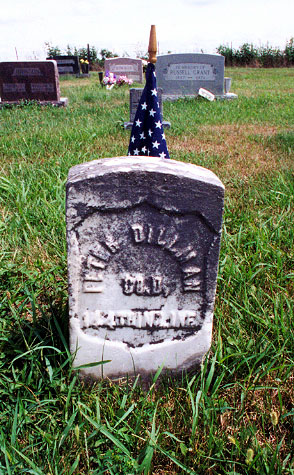
Peter Dillman Co. D 144th Ind. Inf.

 This stone is for my ancestor, Peter Dillman.  He served in the Union Army during the last part of the Civil War in Company D of the 144th Indiana Infantry.  Records I have found say that he enlisted as a Private, but was mustered out as a Corporal.  I have found only a basic synopsis of what his unit did:

Name of Regiment: 144th Infantry Regiment Indiana
Date of Organization: 06 March 1865
Muster Date: 05 August 1865
Regiment Type: Infantry
Officers Killed or Mortally Wounded: 0
Officers Died of Disease or Accident: 0
Enlisted Killed or Mortally Wounded: 0
Enlisted Died of Disease or Accident: 47

Regimental History
One Hundred and Forty-fourth Infantry
INDIANA
(1-YEAR)

One Hundred and Forty-fourth Infantry. -- Col., George W.
Riddle; Lieut.- Col., Henry C. Ferguson; Maj., Thomas Clark.

The 144th was organized at Indianapolis in March, 1865, being
composed of companies raised in the 2nd Congressional
district. It was mustered in March 6, and left the state on
the 9th for Harper's Ferry, Va., where it was assigned to the
1st brigade, 1st provisional division, Army of the Shenandoah.

It was ordered to Halltown, and was stationed at different
times at Charlestown, Winchester, Stephenson's depot and
Opequan creek. It was on guard duty until Aug. 5, 1865, when
it was mustered out.

Its strength was 1,036; and it lost by death, 46; desertion,
19; unaccounted for, 1.

Source: The Union Army, vol. 3, p. 188


Military Monday – We all have ancestors who have served in the military. Military Monday is a place to post their images, stories and records of their service in various branches of the military. Military Monday is an ongoing series by Cindy at Everything’s Relative – Researching Your Family History..   (Blurb shamelessly stolen from Thomas McEntee at Geneabloggers.)